Tuckman's model gives leaders a practical map for guiding groups from confusion to high performance.
Apply Tuckman's framework to your real team
Explore how Tuckman's stages apply to your team and get concrete strategies for every phase of development.
Why Tuckman's model still holds up
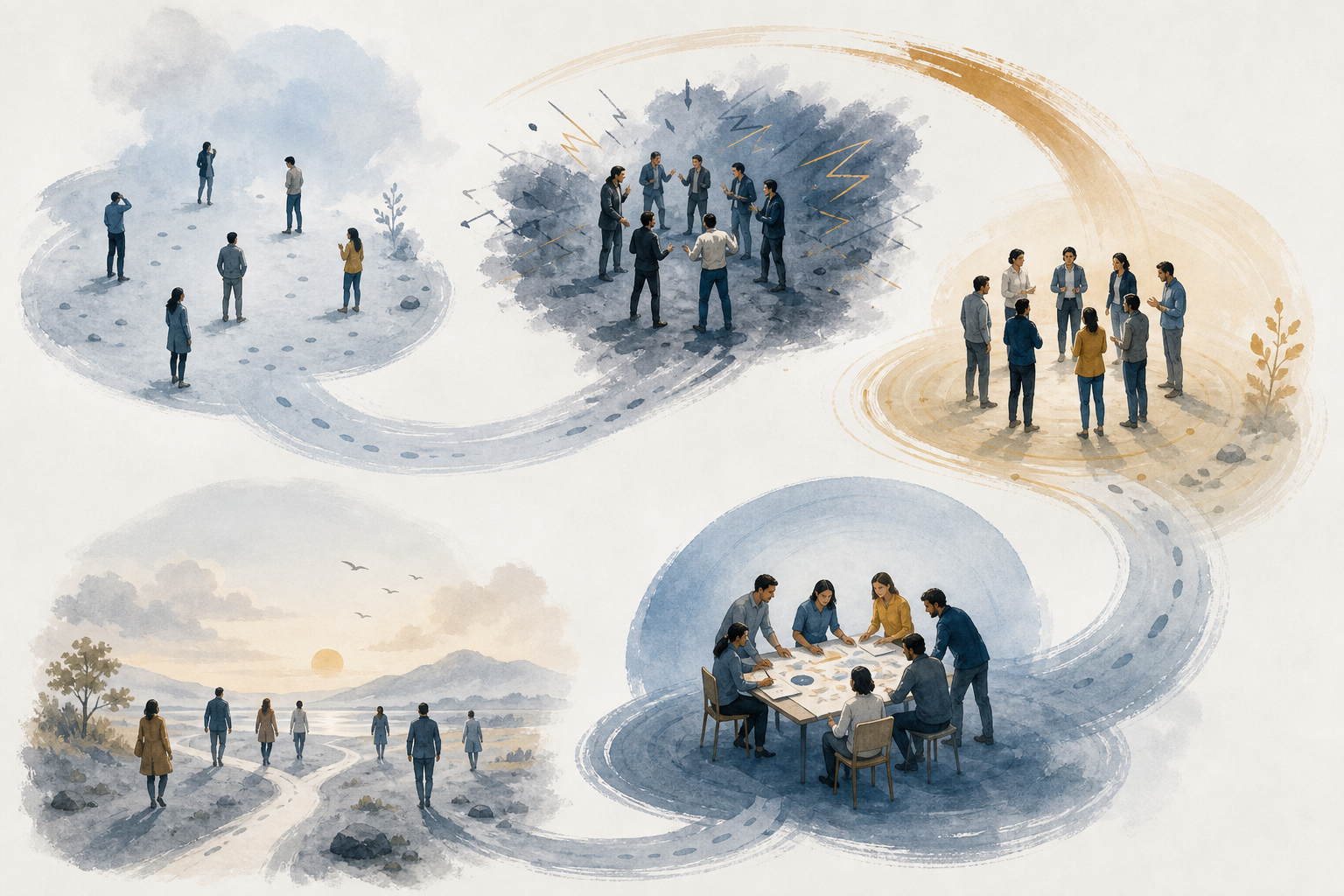
In 1965, American organizational psychologist Bruce Tuckman reviewed fifty published studies on group behavior and identified a consistent pattern: groups do not become high-performing overnight. They move through predictable stages, each with its own dynamics, tensions, and leadership demands. Tuckman argued that these phases are all necessary and inevitable for a team to grow, face challenges, solve problems, and deliver results. That framing matters. Leaders who treat friction as a sign of failure often intervene in ways that slow the very progress they are trying to accelerate. Understanding the model reframes those moments as normal, even necessary, steps in a team's development. In 1977, Tuckman and Mary Jensen added a fifth stage, adjourning, to account for what happens when a group's work is complete and the team dissolves.
Forming and storming: the two stages leaders most often misread
During forming, team members are orienting. Uncertainty is high, conflict is avoided, and people look to a leader for direction and clarity. This is not passivity; it is a rational response to ambiguity. The practical implication is that clear goal-setting at this stage does real work. Defining objectives, roles, and expected ways of working reduces the ambiguity that slows early progress.
Storming arrives when the group begins organizing tasks and interpersonal conflicts surface. Frustration about roles, goals, and constraints gets expressed openly. Behaviors become less polite. This stage is where many leaders panic and either clamp down with more control or disengage entirely. Neither helps. Leading through the storming stage requires creating conditions where conflict can be named and worked through, not suppressed. The leader's job here is to hold the container, not to eliminate the discomfort.
Norming and performing: what cohesion actually looks like
In the norming stage, the group finds its rhythm. Members share ideas and feelings more openly, give and receive feedback, and begin to develop shared norms for how they work together. Creativity rises. Collaboration becomes a genuine operating mode rather than an aspiration. One risk worth noting: teams in norming can become resistant to change, including necessary change, because cohesion starts to feel worth protecting at all costs. A leader's role here is to reinforce the norms that serve the team while staying alert to the ones that are calcifying.
Performing is the stage every team is aiming for. True interdependence is the norm: individuals adapt fluidly to meet each other's needs, and the team self-manages toward its goals. Creativity is high, morale is high, and the leader's job shifts decisively toward enabling rather than directing. Understanding what drives or derails your team at this stage is what separates sustained performance from a brief peak.
Adjourning: the stage most leaders skip
Adjourning, the fifth stage Tuckman added later, addresses what happens when a group's purpose is fulfilled and the team breaks up. This might be the end of a project, a reorg, a product launch, or a team that simply moves on. Leaders often treat this as an administrative moment, not a developmental one. That is a mistake. How a team ends shapes how its members begin the next thing. Acknowledging the work, naming what was built together, and giving people a real sense of closure supports the transition rather than leaving it to fade out. For leaders managing multiple teams or running recurring project cycles, building an intentional adjourning practice pays forward into future team formation.
Why stage-matched leadership outperforms a fixed style
The practical power of Tuckman's model is that it gives leaders permission to lead differently at different moments, not because they are inconsistent, but because the team's needs are genuinely different. Directive structure serves a forming team. Facilitated conflict resolution serves a storming team. Stepping back and trusting the team serves a performing team. Applying the same management approach across all stages is one of the most common and costly leadership errors in scaling organizations. This is closely connected to situational leadership, which formalizes the idea that effective leaders adapt their style to where each person and team actually is. For leaders working across cultures or in cross-functional contexts, collaboration across boundaries adds another layer: different team members may experience the same stage very differently depending on their background and expectations.
A team that understands where it is in its own development can move through friction faster and with far less damage to trust.
How to lead each stage of Tuckman's model
-
Diagnose which stage your team is in
Before applying any strategy, get an honest read on where your team actually is. Look at the quality of interpersonal exchange: are people avoiding conflict, surfacing it, or working through it fluidly? Are roles clear or contested? Is the team self-directing or waiting for instruction? Misdiagnosing the stage is the most common reason well-intentioned leadership interventions backfire. A team that looks like it is performing may actually be in a fragile norming phase where cohesion is protecting groupthink.
-
Provide clear structure during forming
In the forming stage, ambiguity is the main obstacle. Define objectives, clarify roles, and establish how the team will make decisions and communicate. This is not micromanagement; it is the scaffolding that lets people orient. Clear goal-setting at this stage reduces the uncertainty that causes early teams to stall. A leader who withholds structure in the name of autonomy during forming leaves the team without a foundation to build on.
-
Create safe conditions for storming
Storming is not a problem to be solved; it is a process to be facilitated. Frustration about roles, goals, and constraints will surface. Your job is to make it safe for that to happen productively. Name the tension without personalizing it. Separate the interpersonal friction from the substantive disagreement. For a deeper look at what this stage demands of a leader, the storming stage guide covers the dynamics in practical detail. Suppressing conflict during storming does not resolve it; it drives it underground where it becomes harder to address.
-
Reinforce norms and watch for rigidity during norming
As the team settles into shared ways of working, your role is to reinforce the norms that serve performance while staying alert to the ones that have become obstacles. Teams in norming can resist necessary change because cohesion feels worth protecting. Introduce feedback practices that keep the team honest about what is working and what is not. Foster interpersonal connections that deepen trust without creating insularity.
-
Step back and enable autonomy during performing
A performing team does not need a leader at the center of every decision. It needs a leader who protects the conditions that make high performance possible: removing organizational obstacles, securing resources, and shielding the team from unnecessary interference. Allowing the team to self-manage at this stage is not abdication; it is the appropriate leadership posture. Inserting directive control into a performing team is one of the fastest ways to push it back into storming.
-
Close the team intentionally during adjourning
When the team's work is complete, resist the urge to simply move on. Acknowledge what was accomplished, name what the group built together, and give people a genuine sense of closure. This matters for the individuals involved and for the organization's capacity to form high-performing teams in the future. How a team ends influences how its members approach the next team they join. An intentional adjourning practice is a small investment with a meaningful long-term return.
Benefits
A shared language for team friction
Tuckman's model gives leaders and teams a common vocabulary for what they are experiencing, which makes it easier to name tension without personalizing it. Knowing that storming is a normal stage, not a sign of failure, changes how people interpret and respond to conflict.
Stage-appropriate leadership decisions
The model makes clear that the right leadership move depends on where the team is, not on a fixed personal style. Directive structure that helps a forming team can actively harm a performing one. Matching your approach to the team's stage is a concrete, learnable skill.
Faster recovery from setbacks and disruptions
Teams that understand the model recover more quickly from disruptions like reorgs, departures, or scope changes because they can recognize regression for what it is and re-engage the earlier stages deliberately rather than treating the setback as a crisis.
Intentional team closure that carries forward
The adjourning stage is often ignored, but how a team ends shapes how its members begin the next thing. Leaders who close teams intentionally build organizational capacity for high performance over time, not just within a single project.
Tuckman's stages in recognizable team situations
A newly formed cross-functional project team
A senior leader assembles a cross-functional team to deliver a high-stakes initiative. Members come from different departments, have no prior working history together, and are unclear about decision rights. This is a textbook forming situation. The leader's most valuable early move is not inspiration but structure: clear objectives, defined roles, and explicit agreements about how the team will work. Without that scaffolding, the team will spend weeks in orientation that could have been resolved in days. For teams spanning functions or cultures, leading collaboration across boundaries adds relevant depth.
A scaling startup team hitting its first serious friction
A startup that has grown quickly suddenly finds that the informal ways of working that served five people are breaking down with fifteen. Frustration about roles, authority, and priorities surfaces. Leadership may interpret this as a personnel problem when it is actually a storming-stage signal that the team has outgrown its informal structure. The response is not to hire or fire but to facilitate: surface the underlying disagreements, clarify decision rights, and establish the norms the team needs at its current size. This is exactly the dynamic that team development programs are designed to address.
A high-performing team being disrupted by a reorg
A team that has reached the performing stage is restructured, with two members leaving and three new ones joining. The team does not stay in performing; it effectively restarts the cycle. Leaders who understand Tuckman's model know to expect a regression and plan for it rather than being surprised by it. Acknowledging the disruption openly and re-investing in forming-stage clarity for the new configuration is faster than pretending the team can pick up where it left off.
A project team reaching the end of a long engagement
A team that has worked together intensively for over a year completes its project and is about to disband. Without an intentional adjourning process, members simply scatter, often carrying unresolved feelings about the ending. A leader who builds in structured closure, acknowledging contributions, naming what the team accomplished, and marking the transition, supports the psychological completion that makes it easier for people to bring full energy to their next assignment. This is a small but meaningful act of leadership that most organizations skip entirely.
Frequently asked questions about Tuckman's stages of group development
Do all teams move through Tuckman's stages in order?
Tuckman's model describes a sequential progression, and most groups do move through the stages in order. However, teams can and do regress when membership changes, goals shift, or significant disruptions occur. A team that was performing can move back into storming when new members join or the task changes substantially. The model is a map, not a guarantee of linear progress.
What is the biggest leadership mistake at the storming stage?
The most common mistake is suppressing conflict rather than facilitating it. Leaders who shut down disagreement during storming prevent the team from working through the interpersonal and structural tensions that have to be resolved before genuine norming can happen. The result is a team that looks stable on the surface but is carrying unresolved friction that will resurface later, often at a worse moment.
When was the fifth stage, adjourning, added to Tuckman's model?
Bruce Tuckman, together with Mary Jensen, added the adjourning stage in 1977, more than a decade after the original four-stage model was published in 1965. The stage addresses what happens when a group's task is complete and the team dissolves, a phase the original model did not account for.
How does Tuckman's model connect to situational leadership?
Both frameworks rest on the same core insight: effective leadership is not one-size-fits-all. Tuckman's model describes what teams need at each stage of development; situational leadership describes how a leader's style should shift to match those needs. Used together, they give leaders both a diagnostic tool and a practical playbook. You can explore that connection further in the guide to situational leadership.
Ready to lead your team through every stage of development
If you are working with a team that is stuck in friction, unclear about roles, or not yet reaching its potential, understanding where it sits in its development is the starting point. Nordic Leadership Coaching works with leadership teams at every stage of this progression, using research-based tools to diagnose what is actually happening and build what the team needs next. Reach out to explore what that could look like for your team.