Situational leadership gives you a practical framework for adjusting your approach based on each team member's competence and commitment.
Put situational leadership to work on your team
Explore how situational leadership applies to your team and start leading with more precision today.
Why no single leadership style works for everyone
The core insight of situational leadership is simple but frequently overlooked: the most effective leadership style depends on the person and the task, not on the leader's preference. Developed by Dr. Paul Hersey and Ken Blanchard in the 1970s, the model was originally called the "life cycle theory of leadership" before becoming widely known as the Hersey-Blanchard situational leadership model. It argues that leaders who rely on a single fixed approach will inevitably mismatch their behavior to the needs of their team members, either over-directing capable people or under-supporting those who need guidance. The practical consequence is friction, stalled execution, and disengagement, problems that often get blamed on the team when the real issue is a leadership style that does not fit the situation.
Competence and commitment are the two variables that matter
Before choosing a style, a leader needs to diagnose two things: competence (the team member's knowledge, skills, and experience for this specific task) and commitment (their motivation and engagement toward it). Both can range from low to high, and crucially, they are task-specific. A senior engineer who is highly competent in backend architecture may be a complete beginner when asked to lead a cross-functional project, and their confidence may be low as a result. Treating that person as uniformly "experienced" is a diagnostic error. The model works because it forces the leader to assess each person on each responsibility separately, rather than applying a blanket judgment based on seniority or general performance. For leaders managing collaboration across organizational boundaries, this task-specific lens is especially useful.
The four styles and when each one fits
The four primary leadership styles in the Hersey-Blanchard model are directing (S1), coaching (S2), supporting (S3), and delegating (S4). Each style sits on two behavioral dimensions: task behavior (how much direction you give) and relationship behavior (how much support you provide). S1 directing is high task, low relationship: you tell the person exactly what to do and how. S2 coaching is high task, high relationship: you still provide close direction but also invest in building the person's confidence and skills. S3 supporting is low task, high relationship: the person can do the job but needs encouragement or buy-in. S4 delegating is low task, low relationship: you hand over decision-making to someone who is both capable and motivated. The skill is not mastering all four styles in the abstract; it is knowing which one to reach for in a given moment with a given person.
The same employee may need all four styles
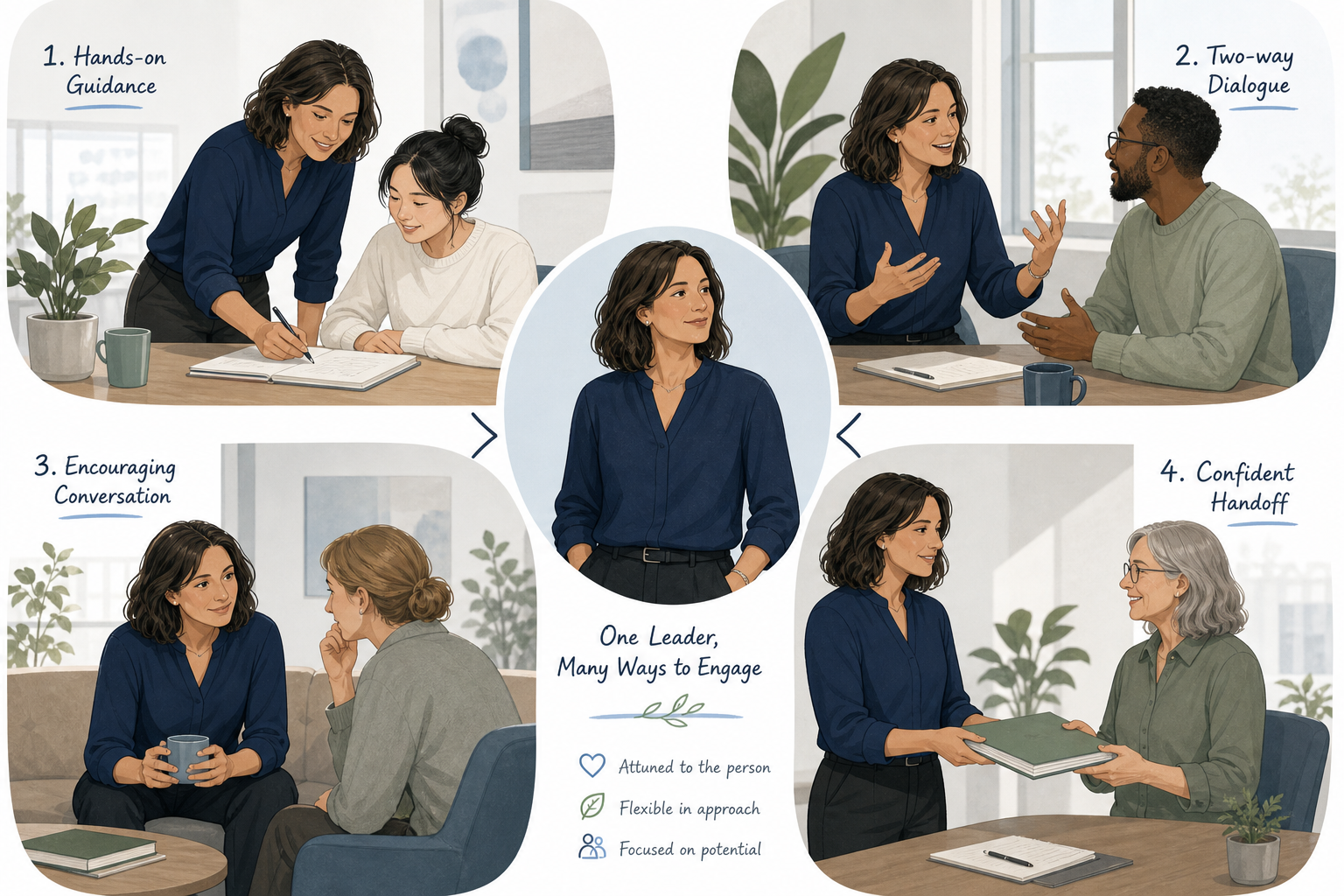
One of the most practically useful features of situational leadership is that it reframes how you think about individual team members. A single person can simultaneously need directing on a new responsibility and full delegation on a familiar one. A product manager who has run launches independently for years may need close coaching when asked to manage a team for the first time. Applying a delegating style because they are "senior" would leave them unsupported at exactly the moment they need guidance. Conversely, directing a highly experienced specialist on work they know better than you do erodes trust and autonomy. This is why leadership coaching often focuses on the diagnostic skill first: the ability to read where someone actually is, not where you assume they should be.
Situational leadership connects to broader development models
The Hersey-Blanchard model does not stand alone. Ken Blanchard later developed a revised version called Situational Leadership II (SLII), which refined the language around development levels and made the diagnostic process more explicit. The underlying logic also connects naturally to group development frameworks: a team moving through the storming phase, for example, will often need more directive and coaching behavior from its leader before it is ready for a supporting or delegating approach. Understanding how teams move through conflict and growth helps leaders anticipate when to shift styles proactively rather than reactively. Situational leadership is also compatible with transformational leadership approaches, which focus on longer-term development; the two frameworks address different time horizons of the same challenge.
The same employee may need close direction on one task and full autonomy on another; the leader's job is to tell the difference.
How to apply situational leadership in practice
-
Identify the specific task, not the person in general
Start with a clearly defined responsibility or task, not a general impression of the team member. Competence and commitment are always task-specific. A person who is confident and skilled in one area may be uncertain and inexperienced in another, so the diagnosis must be done at the task level, not the person level.
-
Assess competence for that task
Ask how much knowledge, skill, and direct experience the person has with this particular task. Have they done it before? Did they succeed? Do they understand the standards expected? Low competence does not mean low ability in general; it means they have not yet developed the skills needed for this specific responsibility.
-
Assess commitment for that task
Commitment covers both motivation and confidence. A person may be willing but anxious (high motivation, low confidence), capable but disengaged (high competence, low motivation), or enthusiastic and skilled. Each combination calls for a different leadership response, so it is worth taking time to distinguish between reluctance rooted in uncertainty versus reluctance rooted in disengagement.
-
Select the matching leadership style
Match your style to the diagnosis: directing for low competence and low commitment, coaching for low-to-moderate competence paired with motivation, supporting for high competence but low confidence or willingness, and delegating for high competence and high commitment. Resist defaulting to your preferred style; the match is what matters. A leadership development program can help leaders practice this diagnostic flexibility across a range of real scenarios.
-
Communicate your approach transparently
Shifting your style can feel confusing or even inconsistent to team members if it happens without explanation. Naming your reasoning, briefly and directly, builds trust. Saying "I want to stay closely involved while you are getting started with this" is very different from simply hovering. Transparency about why you are leading a certain way turns a management technique into a development conversation.
-
Reassess as competence and commitment change
Development is not static. As a person gains experience and confidence in a task, the appropriate leadership style should shift toward less direction and more autonomy. Failing to adjust as people grow is one of the most common mistakes in situational leadership. Build in regular check-ins to reassess where each person is, and be willing to move the style in either direction if circumstances change.
Benefits
Reduces friction from style mismatch
Many team performance problems trace back to a mismatch between how a leader leads and what a team member actually needs. Diagnosing competence and commitment before choosing a style addresses the root cause rather than the symptom.
Builds autonomy without abandoning support
Situational leadership gives leaders a principled way to extend autonomy progressively. Delegation is earned through demonstrated competence and commitment, not assumed based on seniority, which makes the process fair and legible to the team.
Works across different roles and cultures
Because the model is task-specific rather than person-specific, it applies across roles, seniority levels, and cultural contexts. Leaders working across Nordic and U.S. organizational cultures, where expectations around autonomy and direction often differ, find the framework especially useful for calibrating their approach.
Accelerates individual development
When leaders adjust their style to match a person's current development level, they create the conditions for faster growth. Coaching (S2) builds skills and confidence simultaneously, and moving through the styles over time gives team members a clear developmental trajectory.
Situational leadership in recognizable scenarios
A new hire joining an experienced team
Nearly all new employees need a more directive style of leadership at the start. They may be highly capable in their field but are unfamiliar with this organization's processes, expectations, and priorities. Directing (S1) is the appropriate starting point, not because the person lacks talent, but because they genuinely lack the context to work independently. As they build familiarity and confidence, the leader can shift progressively toward coaching and then supporting.
A skilled specialist asked to lead for the first time
A technically expert individual contributor who is promoted into a people management role faces a task they have no direct experience with. Their competence in leadership is low even though their domain competence is high. A coaching style (S2) fits this transition: close involvement, clear guidance on what good leadership looks like, and consistent encouragement as they build the skills. Delegating at this stage, because the person is "senior," would be a diagnostic mismatch.
An experienced team member showing disengagement
When someone has the ability to do a task well but is reluctant or disengaged, the issue is commitment, not competence. A supporting style (S3) is most appropriate here: the leader reduces directive behavior and focuses instead on listening, understanding what is driving the reluctance, and restoring motivation. This is common in teams experiencing friction or unclear roles, areas where team development programs often intervene.
A high-performing team running a familiar process
A team that has executed a well-defined process many times, with consistent results and high motivation, does not benefit from close oversight. Delegating (S4) respects their capability and autonomy, and micromanaging at this stage actively undermines performance and trust. The leader's role shifts to removing obstacles and staying available, not directing the work. This is the style that scales best in high-trust, high-competence environments.
Common questions about situational leadership
What is situational leadership in simple terms?
Situational leadership is a framework that holds no single leadership style is effective in all situations. Instead, leaders diagnose each team member's competence and commitment for a specific task, then choose one of four styles, ranging from directing to delegating, that best fits that person's current development level on that task.
Who developed the situational leadership model?
The model was developed by Dr. Paul Hersey and Ken Blanchard in the 1970s, originally under the name "life cycle theory of leadership." Blanchard later developed a refined version called Situational Leadership II (SLII), which updated the language around development levels.
Can the same person need different leadership styles at the same time?
Yes, and this is one of the model's most important practical points. Because competence and commitment are task-specific, the same team member may need close direction on a new responsibility while deserving full delegation on a familiar one. Treating a person as uniformly "experienced" or "junior" ignores this task-level variation.
What is the difference between coaching and supporting in situational leadership?
Both styles involve high relationship behavior, but they differ in task direction. Coaching (S2) combines high task direction with high support: the leader still guides closely while building the person's skills and confidence. Supporting (S3) reduces task direction because the person already has the competence; the leader's focus shifts to motivation and engagement rather than instruction.
How does situational leadership relate to team development stages?
The two frameworks align closely. A team in an early or conflict-heavy stage of development typically needs more directive and coaching behavior from its leader. As the team matures and trust builds, the leader can shift progressively toward supporting and delegating styles. Understanding how teams move through the storming stage helps leaders anticipate when that shift is appropriate.
Build the diagnostic skill that makes leadership actually fit your team
Situational leadership is a diagnostic skill, and like any skill, it develops through practice and feedback. If you want to build the flexibility to lead different people differently, and to do it consistently under pressure, executive coaching or a team development program can give you the structured practice and real-time feedback that makes the difference.