Understanding the storming stage of group development helps leaders turn friction into the foundation for genuine team cohesion.
Help your team move through storming with clarity
Understand the storming stage clearly so you can lead your team through conflict and toward lasting cohesion.
Where the storming stage fits in team development
Bruce Tuckman introduced his model of group development in 1965, describing four stages that teams move through: forming, storming, norming, and performing. A fifth stage, adjourning, was added later with colleague Jensen. Tuckman argued that these phases are all necessary and inevitable for a team to grow, tackle problems, and deliver results. Storming is the second stage. It follows the initial forming phase, where a team comes together with relative politeness and surface-level harmony, and precedes norming, where genuine cohesion begins to take hold. The model is widely used in management education and team development practice precisely because it maps so well to what leaders and team members actually experience.
What actually happens during storming
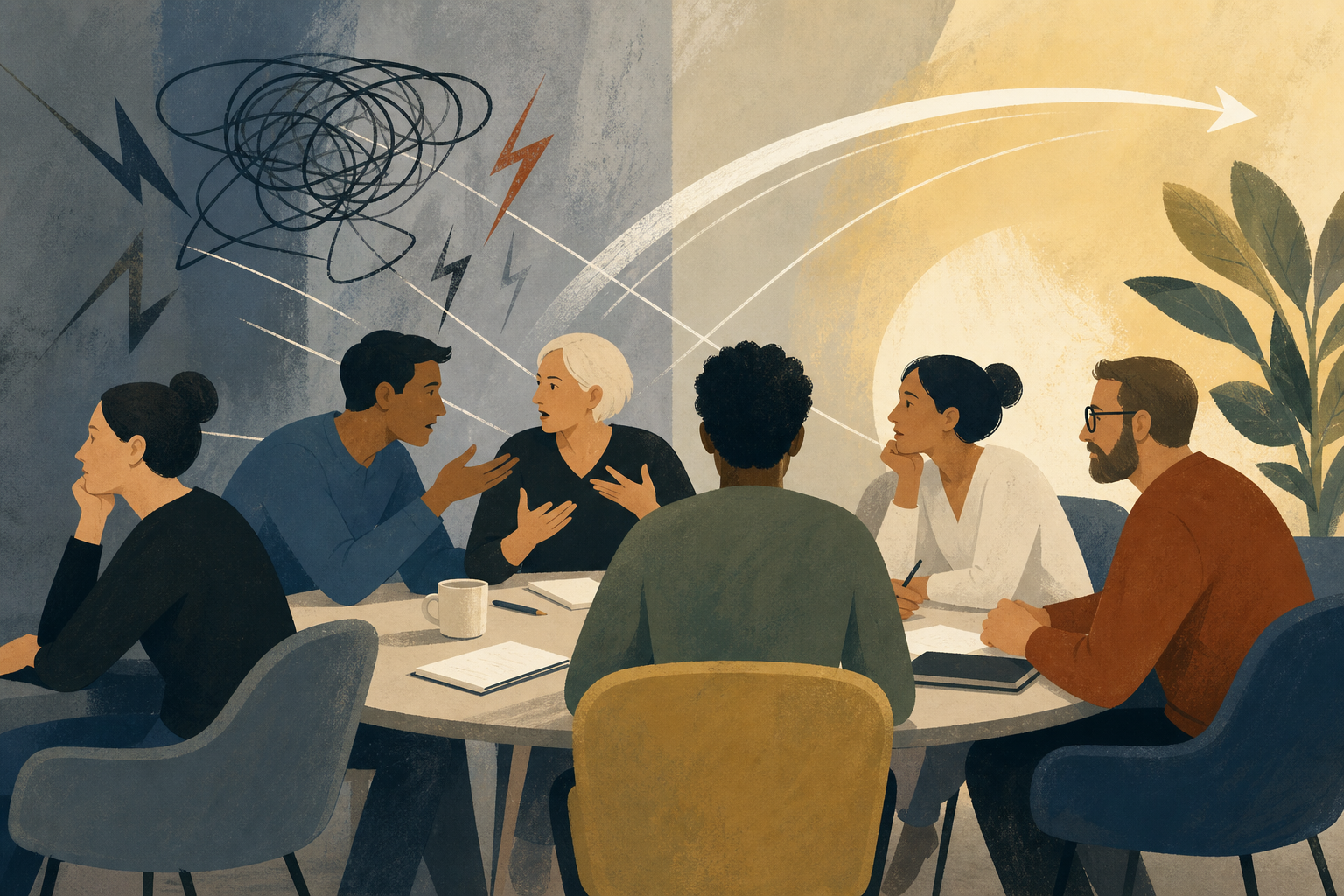
The forming stage creates a kind of superficial harmony, built more on manners and the novelty of working together than on genuine mutual understanding. Storming is when that surface breaks. Team members begin asserting their personalities, competing for roles and influence, and challenging each other and the leader. Frustration surfaces. Disagreements about goals, responsibilities, and working styles come into the open. Subgroups and cliques can form around strong personalities or shared opinions.
This is also why team performance often dips during storming. Energy that could go toward output gets redirected into interpersonal friction and unresolved tension. That dip is not a sign of a failing team. It is a predictable consequence of people starting to engage honestly with each other rather than staying politely on the surface.
Why conflict here is a sign of progress
It is tempting to treat storming as a problem to be eliminated. The more useful frame is to treat it as evidence that the team is developing. When people start pushing back, debating ideas, and competing for influence, it means they are genuinely invested in the work and in their place within the group. That engagement, however uncomfortable, is what eventually produces the trust and clarity that norming and performing require.
Storming can also be a highly creative stage: ideas get generated and challenged, and important issues that might otherwise stay buried finally get aired. The goal for a leader is not to suppress this energy but to channel it. Teams that skip or suppress storming tend to carry unresolved tension forward, where it quietly undermines cohesion and execution later. For leaders interested in transformational approaches to team dynamics, understanding storming is foundational.
The path from storming into norming
Teams do not exit storming automatically. The transition requires that the core conflicts, disagreements over roles, personality clashes, and competition for influence, get resolved well enough that the group can move forward together. When that happens, something shifts. Consensus begins to form around leadership, roles, and how the group will work. Interpersonal differences get worked through rather than avoided. A sense of cohesion emerges, and team performance starts to climb again.
This is the norming stage: not perfect agreement, but enough shared understanding to function as a unit. Not every team gets there. Some stay stuck in storming, or cycle back into it when new challenges or members arrive. The difference is often whether the leader actively facilitates the transition rather than waiting for it to happen on its own. Leadership coaching can be a useful resource for leaders who find themselves navigating this transition repeatedly or under pressure.
Conflict in a team is not a sign that something has gone wrong; it is often the first sign that something real is beginning.
How to lead a team through the storming stage
-
Name what is happening without alarm
When conflict and friction appear, many leaders either panic or pretend not to notice. A more effective first move is to name the dynamic directly: the team is in a normal and expected phase of development, not falling apart. Telling the team that storming is a recognized and necessary part of growth reduces anxiety and helps members interpret their own frustration as something meaningful rather than something to hide. This reframe alone can shift the group's relationship to its own conflict.
-
Clarify roles, goals, and decision rights
Much of the conflict in storming is fueled by ambiguity about who owns what. Competing for influence becomes less necessary when responsibilities are clearly assigned. Work with the team to make roles explicit, not just job titles but who makes which decisions, who has input, and who is accountable for what outcomes. This is especially important in scaling organizations where structure has not kept pace with growth. A leadership development program that addresses role clarity early can prevent much of the dysfunction that storming produces.
-
Create structured space for disagreement
Suppressing conflict does not resolve it. Instead, create structured opportunities for honest conversation: team retrospectives, facilitated discussions, or one-on-one conversations where concerns can surface safely. The goal is not to eliminate disagreement but to make it productive. When people know there is a legitimate channel for their frustration, they are less likely to let it leak into passive resistance or side conversations that undermine team cohesion.
-
Mediate specific conflicts rather than avoiding them
When interpersonal tensions become visible, address them directly rather than hoping they resolve themselves. This does not mean taking sides. It means helping the people involved articulate their underlying concerns, find common ground, and agree on a way forward. Unresolved personality clashes and role disputes are the most common reasons teams get stuck in storming and never reach norming. A leader willing to engage with specific conflicts, not just the general atmosphere, is far more likely to move the team forward.
-
Build shared norms deliberately
The norming stage does not arrive on its own. It is built. Help the team establish explicit agreements about how they will work together: how decisions get made, how disagreements will be handled, what communication looks like, and what the group values. These norms do not need to be elaborate. Even a short, practical working agreement gives the team a shared reference point that reduces the friction of storming over time.
-
Stay consistent and visible as a leader
During storming, teams are often testing the leader as much as they are testing each other. Consistency in behavior, communication, and follow-through signals that there is a stable foundation beneath the turbulence. Leaders who become reactive, withdraw, or shift position under pressure tend to amplify the storming dynamic rather than contain it. Steady presence does not mean rigidity; it means the team can trust that the leader will not disappear when things get hard.
Benefits
Conflict becomes a diagnostic tool
Understanding the storming stage means leaders can read team conflict as information rather than reacting to it as a crisis. Friction over roles, goals, or authority is often a signal about what needs to be clarified, not evidence that the team is broken.
Teams reach norming faster with active leadership
Teams that are actively guided through storming, through role clarity, structured dialogue, and deliberate norm-setting, transition to norming more reliably than teams left to resolve conflict on their own. The leader's role is not passive during this stage.
Suppressed storming creates hidden risk
Teams that skip or suppress the storming stage do not avoid the underlying tension. They carry it forward, where it quietly undermines trust and execution in the norming and performing stages, often without anyone being able to name why.
The model applies across team types and cultures
Tuckman's framework applies to project teams, leadership teams, and cross-cultural groups alike. Recognizing which stage a team is in allows leaders to adapt their approach rather than applying the same intervention regardless of where the group actually is in its development.
Storming in practice: what it looks like in real teams
A scaling startup after a hiring surge
A fast-growing startup doubles its team in a short period. The original core members, who built informal ways of working together, suddenly find their authority and influence unclear. New hires bring different assumptions and push back on established practices. Competing visions for how work should be done surface quickly. This is storming in a high-stakes environment. The leadership task here is to clarify decision rights and create structured onboarding into the team's norms before the conflict becomes entrenched.
A cross-functional project team under deadline pressure
A project team assembled from different departments begins well, but as the deadline approaches and trade-offs become necessary, members start advocating for their own function's priorities over the group's shared goals. Subgroups form. Frustration about roles and accountability rises to the surface. This is a textbook storming pattern, and it is intensified by time pressure. A leader who names the dynamic, surfaces the competing priorities explicitly, and facilitates a real conversation about trade-offs can move the team through it faster than one who simply pushes harder on output.
A Nordic-U.S. leadership team navigating cultural friction
A Nordic company expands into the U.S. market and builds a joint leadership team. The Nordic members expect flat decision-making and high autonomy, while the U.S. members expect clearer hierarchy and faster decisions from the top. Neither group is wrong, but the difference in expectations produces real friction during storming. Naming the cultural dimension of the conflict, rather than treating it as purely interpersonal, is essential for moving this kind of team toward genuine norming.
A leadership team after a change in senior leadership
An established team that had reached norming or performing can be thrown back into storming when a key leader departs or a new one arrives. Existing role agreements become uncertain, and members begin competing for influence in the new configuration. Leaders who recognize this regression as a predictable feature of the model, rather than a failure of the team, are better positioned to guide the group back through the stages without panic or blame.
Common questions about the storming stage of group development
Is the storming stage unavoidable for every team?
Not every team experiences storming in the same way or at the same intensity. In Tuckman's original 1965 research, only about 50% of the studies identified a clear stage of intragroup conflict, and some groups moved directly from forming to norming. That said, the underlying tensions that storming represents, competing for roles, clarifying expectations, and working through personality differences, tend to surface eventually in most real teams, even if not all at once.
What happens if a team never gets through the storming stage?
Teams that do not resolve the core conflicts of storming often stall. They may stay in a state of chronic low-level friction, where unresolved role disputes and interpersonal tensions prevent the cohesion that norming requires. Some teams cycle back into storming repeatedly, especially when new challenges or new members arrive, without ever establishing the shared norms that would let them perform consistently.
Can a team go back to storming after reaching norming or performing?
Yes. A significant change, such as a new leader joining, a major shift in goals, or rapid team growth, can push a team that had reached norming or even performing back into storming. This regression is a normal feature of the model, not a failure. Recognizing it as such allows leaders to respond with the right interventions rather than treating the return of conflict as an unexpected crisis.
What is the leader's primary role during the storming stage?
During storming, the leader's role shifts from setting direction (as in forming) to actively facilitating the group's ability to work through conflict. This includes clarifying roles and decision rights, creating structured space for honest conversation, mediating specific disputes, and helping the team build explicit shared norms. Leaders who withdraw or become reactive during this stage tend to prolong it.
Ready to help your team move past friction and into real cohesion
If your team is stuck in conflict, unclear on roles, or losing momentum, that is a solvable problem. Nordic Leadership Coaching works with leadership teams and organizations to move through the storming stage with clarity and purpose, using research-based models and practical facilitation grounded in real-world experience.