
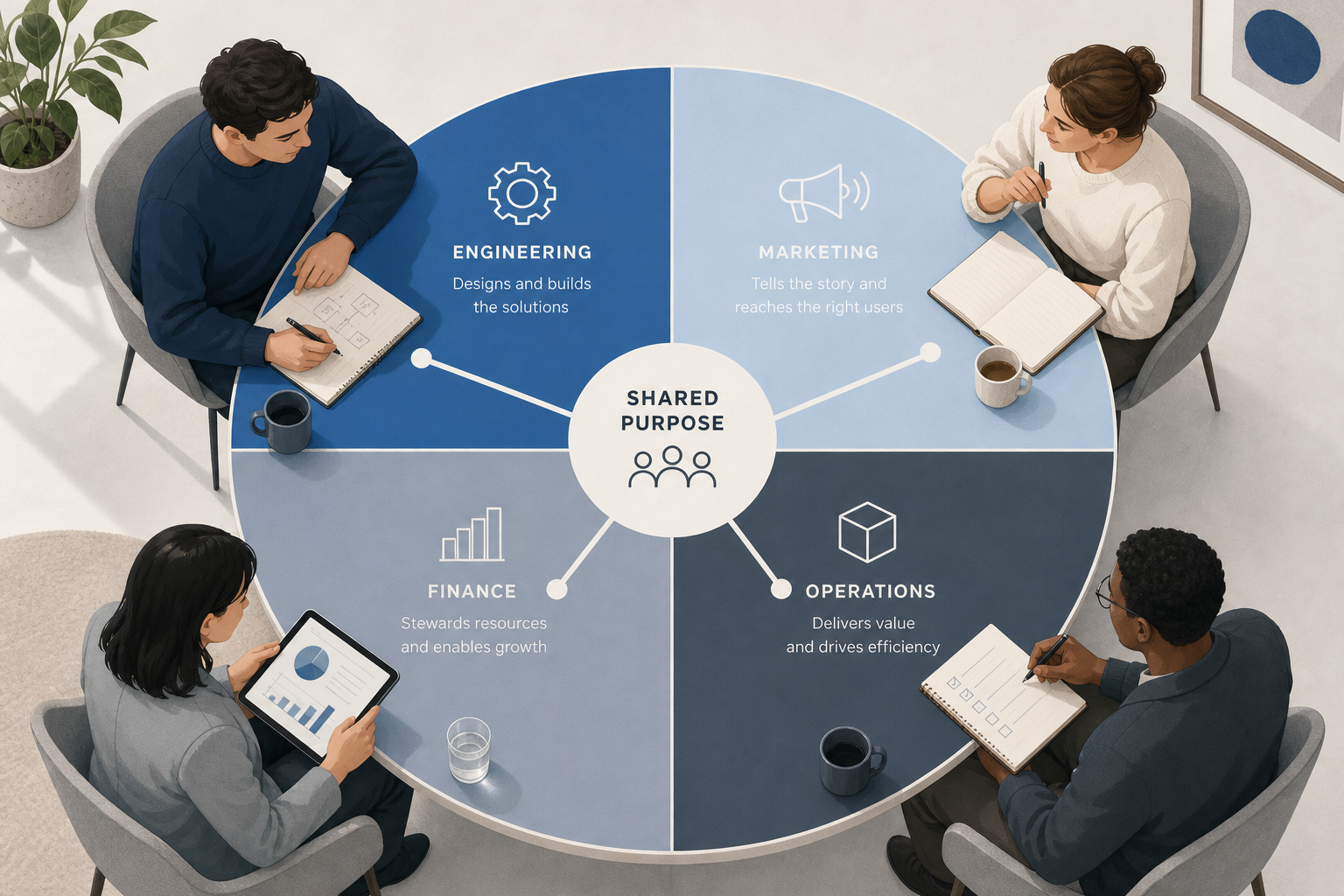
Cross-functional teamwork fails more often than it succeeds. Here is what effective leaders do differently.
Build the cross-functional leadership skills your team needs
Explore coaching and team development programs designed for leaders navigating complexity across departments and cultures.
Why cross-functional teams fail at such high rates
The numbers are stark. Approximately 75% of cross-functional teams are dysfunctional, measured against criteria like staying on schedule, meeting budget, adhering to specifications, and maintaining alignment with corporate goals. That is not a marginal failure rate. It means the default outcome for most cross-functional efforts is underperformance.
The structural reason is straightforward: team members still report to their home departments. A product manager answers to a VP of Product. A finance analyst answers to a CFO. When the cross-functional project's demands compete with departmental priorities, competing loyalties create friction that no project management tool can resolve. The cross-functional leader typically has no formal authority over any of these people, which means influence, clarity, and trust become the primary leadership levers.
Trust and shared purpose come before tasks
The instinct in most organizations is to launch a cross-functional team by assigning work. Kick off the project, distribute the tasks, set the deadlines. The problem is that people from different functions do not yet share a working relationship, a common language, or a reason to prioritize this team's goals over their own department's.
Building trust before diving into tasks is not a soft luxury. It is what determines whether team members will flag problems early, ask for help across functional lines, or stay silent until a deadline collapses. Psychological safety matters here specifically because cross-functional contributors are often evaluated by their home department, not by the shared project. When team members don't feel safe to contribute openly, they default to protecting their own function's interests. Invest real time in the formation stage: clarify why this team exists, what success looks like for everyone, and how each person's expertise contributes to the shared goal. This is the foundation that everything else rests on. For a deeper look at what happens when teams skip this stage, see how conflict and growth show up in team development.
Decision rights and role clarity are not optional
One of the most consistent sources of cross-functional dysfunction is ambiguity about who decides what. When decision authority is unclear, things fall through the cracks. People wait for someone else to act. Escalations pile up. FranklinCovey research found that 92% of employees spend multiple hours each week waiting for clarity or resolving misalignment, a staggering tax on productivity that compounds in cross-functional settings where no single manager owns the whole picture.
The practical fix is to make decision rights explicit, not assumed. For each major category of decision the team will face, name who has authority, who provides input, and who simply needs to be informed. This is not bureaucracy. It is the scaffolding that lets a team move without constant negotiation. Clarifying who sets priorities is especially important when team members are partially allocated and still fielding requests from their functional managers.
Bridging professional languages across functions
Engineers talk in systems and APIs. Marketers talk in campaigns and conversion. Finance talks in risk and return. When these groups sit in the same room, they often assume they understand each other and frequently do not. This is not a communication skills deficit so much as a structural reality: each function has developed its own vocabulary because it optimizes for different things.
Effective cross-functional leaders treat translation as a core part of their job. That means restating decisions in terms each function can connect to their own work, creating shared definitions for key terms at the outset, and explicitly naming when a disagreement is really a language problem rather than a substantive conflict. Regular structured check-ins, brief and focused, help surface misalignments before they harden into friction. The goal is not to flatten functional expertise but to build enough shared language that the team can actually use it.
Maintaining momentum with partial contributors
Most cross-functional team members are not fully dedicated to the effort. They carry responsibilities in their home departments simultaneously, which means their attention is divided and their availability is unpredictable. This is one of the harder structural realities to manage, and it is where many leaders lose momentum.
The practical approach is to design for partial availability rather than fight it. Keep the team within a workable size: research suggests five to nine members is the effective range, small enough to coordinate without excessive overhead, large enough to cover the necessary functional expertise. Define clear deliverables for each contributor with enough lead time that they can negotiate capacity with their functional manager in advance. And make progress visible to the whole team, not just to the leader. When contributors can see how their piece connects to the whole, they are more likely to protect time for the shared work. Leaders who want to develop these skills more systematically can explore leadership development programs built around real execution challenges.
Influence, clarity, and trust become the primary leadership levers when you have no formal authority over the people you depend on most.
How to lead a cross-functional team step by step
-
Define the mission before forming the team
Before recruiting members from across the organization, get precise about what the team exists to accomplish and why it requires cross-functional input. A vague mandate produces a team that drifts. A specific, time-bound mission with clear success criteria gives every contributor a reason to show up fully. Write the mission in one sentence that anyone in the organization could understand, regardless of their function.
-
Select members for coverage and workability
Choose members based on which functions need to be represented to achieve the mission, and keep the group between five and nine people. Below five, you risk missing critical functional expertise. Above nine, coordination overhead starts to outweigh the benefits. Confirm each person's actual availability before they join. A partially available member who cannot protect any time for the team is worse than a gap in the roster.
-
Build shared purpose before assigning tasks
Run a structured launch session focused on relationships and shared context before any task assignment. Have each member explain what their function does, what pressures they are under, and what a successful outcome looks like from their perspective. This surfaces potential conflicts early and builds the mutual understanding that makes honest communication possible later. Leaders who understand group development stages will recognize this as the critical forming work that determines how the team handles pressure. See how to lead through the storming stage when that pressure arrives.
-
Map decision rights explicitly
For each category of decision the team will face, document who decides, who is consulted, and who is informed. Share this map with the team and with each member's functional manager. This single step prevents most of the escalation loops and waiting time that drain cross-functional teams. Revisit the decision map when the team's scope changes or when new friction emerges.
-
Create a communication rhythm that bridges silos
Establish a regular cadence of short, structured check-ins focused on progress, blockers, and inter-functional dependencies. Keep these brief enough that partial contributors can attend consistently. Between sessions, use a shared space where decisions and updates are visible to the whole team, not just circulated to those who happened to be in a given meeting. The goal is to replace informal information asymmetry with deliberate transparency.
-
Actively manage competing loyalties
When a team member's functional manager pulls them toward departmental work, the cross-functional leader's job is to negotiate, not escalate. This means having regular conversations with functional managers about the team's priorities, making resource conflicts visible early, and framing the cross-functional work in terms that connect to what the functional manager cares about. Influence without authority is a learnable skill, and it is the core of cross-functional leadership coaching.
Benefits
Faster execution across the organization
Companies that prioritize cross-functional collaboration see project completion speeds increase by up to 30%. The mechanism is reduced handoff friction and fewer escalation loops when authority and communication structures are clear from the start.
Decisions that stick across functions
When decision rights are mapped explicitly, each function knows what it owns and what it defers to others. This eliminates the rework and reversal that happens when a decision made in one function gets overridden by another that was never consulted.
Innovation that single teams cannot produce
Cross-functional collaboration is associated with a 20% increase in innovation output, because combining different functional perspectives surfaces solutions that no single discipline would reach alone.
Revenue growth linked to collaboration culture
Research from i4cp found that companies promoting cross-functional collaboration are 1.5 times more likely to report above-average revenue growth, suggesting the organizational benefit extends well beyond individual projects.
Reduced leadership risk during scaling
For growing companies, cross-functional clarity reduces the founder bottleneck and prevents the execution gaps that appear when leadership coordination has not kept pace with organizational complexity.
Cross-functional leadership in practice
A product launch team stalling on priorities
A scaling company assembles a team from product, engineering, marketing, and finance to launch a new product line. Six weeks in, engineering is building features that marketing has not yet validated, and finance has not signed off on the go-to-market budget. The team is busy but not coordinated. The underlying problem is that no one mapped decision rights at the outset: each function assumed another had authority over the shared decisions. Bringing the team back to an explicit decision map, and running a focused session to surface each function's actual constraints, restores forward movement faster than adding more meetings.
A Nordic-U.S. cross-border team misreading each other
A Nordic company expanding into the U.S. market builds a cross-functional team that includes both Swedish and American members. The Swedish members operate with a high-trust, consensus-oriented style that reads as slow and indecisive to their U.S. counterparts, while the American members' directness reads as dismissive to the Swedish team. The friction is cultural as much as functional. A leader who can name this dynamic explicitly, and create space for both styles to be understood, prevents the team from fragmenting along national lines.
A VC-backed startup with a founder bottleneck
A fast-growing startup has a founder who is the de facto decision-maker for every cross-functional question, from hiring to product direction to investor communications. As the company scales, this bottleneck slows every team that depends on cross-functional coordination. The fix is not to remove the founder from decisions but to clarify which decisions genuinely require founder input and which can be delegated to a cross-functional team with clear authority. This is exactly the kind of leadership infrastructure work that protects portfolio value during rapid growth.
An operations and marketing team with a language gap
A cross-functional team of operations and marketing professionals is tasked with improving the customer onboarding process. Operations frames the problem in terms of process steps and error rates. Marketing frames it in terms of customer experience and brand perception. Both are right, but they keep talking past each other in planning sessions. Creating a shared glossary at the team's first working session, and assigning one person to translate between operational and customer-experience language in each meeting, cuts the misalignment time significantly.
Questions about cross-functional teamwork
What is the most common reason cross-functional teams fail?
The most consistent cause is a combination of unclear decision authority and competing loyalties. Team members still report to their home departments, so when the cross-functional project's demands conflict with departmental priorities, there is no structural mechanism to resolve the tension. Without explicit decision rights and a leader who actively manages the competing demands, the team defaults to functional silos.
How large should a cross-functional team be?
Research points to five to nine members as the effective range. Fewer than five risks leaving out functional expertise the team needs. More than nine creates coordination overhead that starts to outweigh the benefits of having broader representation. Confirming each member's actual availability before they join is as important as the headcount itself.
How does a cross-functional leader influence without formal authority?
Influence without authority depends on trust, clarity, and relevance. Leaders who invest in building relationships across functions, make the team's mission legible in terms each function cares about, and keep decision rights transparent are more effective than those who rely on positional pressure. Regular communication with functional managers, framing the shared work in terms of what those managers value, is a practical and underused lever.
What is the difference between a cross-functional team and a matrix organization?
A matrix organization is a permanent reporting structure where employees formally report to both a functional manager and a project manager. A cross-functional team is typically temporary and mission-driven, assembled to achieve a specific goal and then disbanded. The reporting lines in a cross-functional team remain in the home departments, which is precisely why decision authority and communication structures need to be established deliberately rather than assumed.
How does cross-functional leadership connect to broader leadership development?
Leading across boundaries requires a specific set of skills: influence without authority, cross-cultural communication, conflict navigation, and structural clarity. These are learnable through deliberate practice and coaching. Leaders who develop these capabilities become more effective not just in cross-functional contexts but in any situation that requires aligning people who do not share a reporting line. Explore leadership development programs or one-on-one leadership coaching for structured support.
Ready to lead across boundaries with clarity and confidence
If cross-functional friction is slowing your team's execution, the underlying causes are almost always structural: unclear decision rights, competing loyalties, and communication gaps that no tool resolves on its own. Nordic Leadership Coaching works with leaders and teams to address these dynamics directly, using practical frameworks grounded in real organizational experience. Reach out to explore what focused coaching or team development could make possible for your team.