Practical frameworks and metrics to evaluate behavior change, business impact, and ROI from leadership development.
Turn leadership investment into measurable outcomes
Discover how to move beyond satisfaction scores and measure the leadership shifts that actually drive results.
Why most programs skip measurement and pay for it
Organizations spend significantly on leadership development, yet fewer than one in four measure its business impact in a systematic way. The gap is rarely about intent. It is about timing: measurement is treated as something that happens after a program ends, rather than something designed into it from the start. When evaluation is bolted on at the end, the baseline data needed to show change simply does not exist. The result is that programs get renewed on the basis of participant satisfaction rather than evidence of behavior change or organizational outcomes. Designing measurement before the program launches is the single most important structural decision an organization can make. Without it, you cannot distinguish a program that transformed leadership from one that merely felt good in the room.
The Kirkpatrick model applied to leadership programs
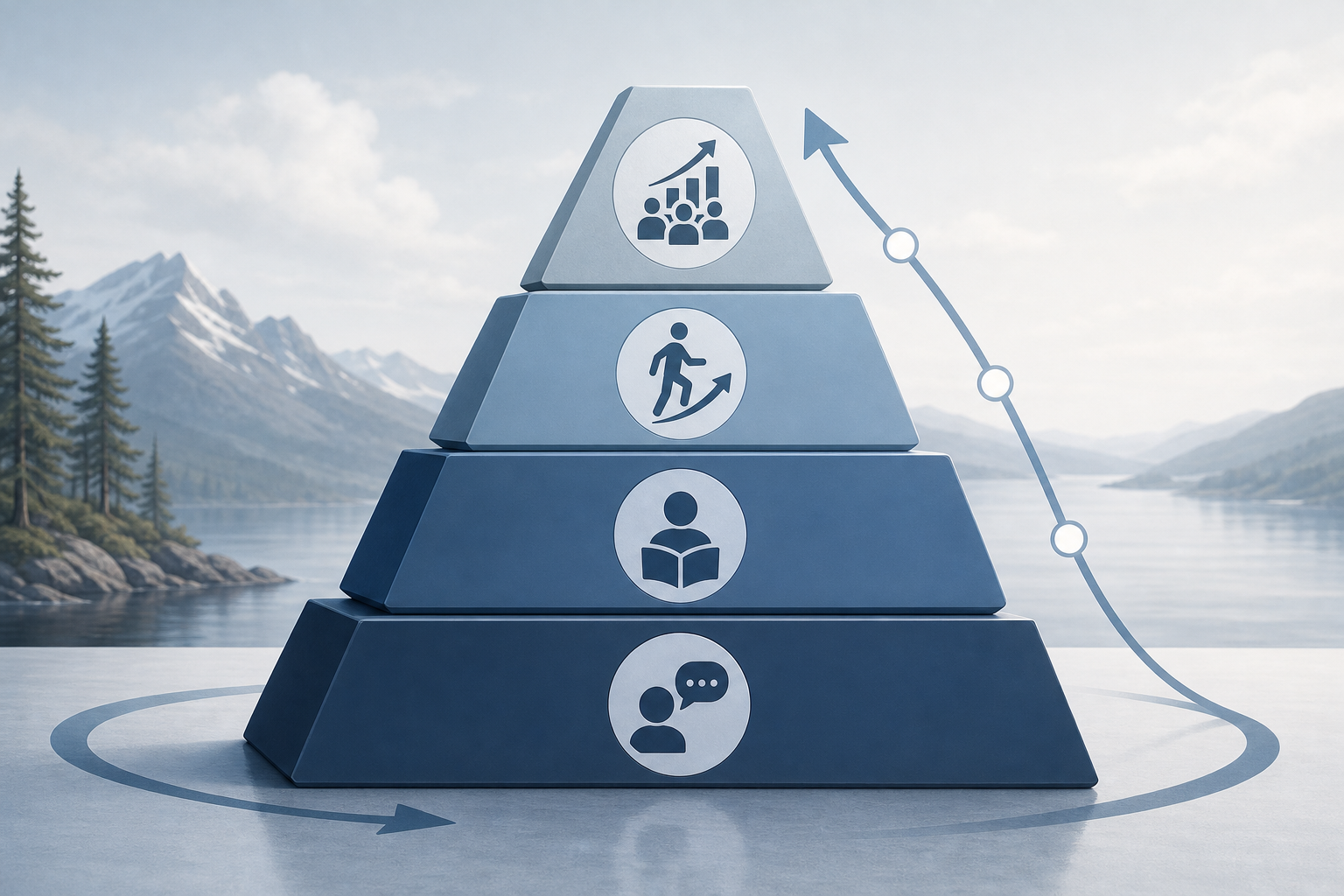
Developed by Donald Kirkpatrick in 1959 and refined over subsequent decades, the four-level Kirkpatrick model remains the most widely cited evaluation framework in organizational learning. The four levels are: Level 1 (Reaction) captures whether participants found the program relevant and engaging. Level 2 (Learning) measures whether knowledge or skills were actually acquired. Level 3 (Behavior) asks whether participants apply what they learned back in their roles. Level 4 (Results) connects those behavior changes to organizational outcomes such as retention, engagement, or execution speed. A 2016 update by Jim and Wendy Kirkpatrick introduced the New World Kirkpatrick Model, which resequences program design to begin at Level 4 and work backward to Level 1. The logic is direct: if you do not know what business result you are trying to produce, you cannot design a program or an evaluation that will produce it. For leadership programs specifically, Levels 3 and 4 are where the real measurement challenge lives, because leadership behavior changes slowly and organizational results are shaped by many factors at once.
Measuring behavior change: the hardest and most important level
The knowing-doing gap is one of the most persistent problems in leadership development. A leader can score well on a post-program knowledge assessment and still revert to old patterns under pressure. Behavior change requires time, opportunity, and reinforcement, none of which a single training event can guarantee. Measuring it well means establishing a baseline before the program begins. That baseline might come from a 360-degree assessment, structured stakeholder interviews, a behavioral rubric, or another repeatable measure. What matters is that you evaluate the same leadership capability before and after the development work. After the program, gather observations from managers, peers, and direct reports at regular intervals to catch real behavior shifts rather than self-reported confidence. Surveys and structured interviews work well for this. The intervals matter: behavior change is rarely visible immediately after a program ends, so building in multiple observation points over time gives a far more accurate picture than a single post-program survey.
Connecting leadership behavior to business outcomes
Level 4 is where leadership development either justifies itself or does not. Common metrics organizations track include employee retention rate, internal promotion rate, team engagement scores, project on-time completion rate, and revenue per leader. The Phillips ROI Methodology extends the Kirkpatrick model with a fifth level: a formal cost-benefit analysis that converts program outcomes into financial terms. Use the Phillips approach when a cost-benefit calculation is specifically required; use Kirkpatrick when you need a general evaluation framework that covers the full range of learning outcomes. The practical challenge at this level is attribution. Leadership behavior is one input among many into a business result, so isolating its contribution requires care. Comparison groups, pre-and-post trend analysis, and stakeholder interviews that ask specifically about leadership-driven changes all help build a credible case. Studies cited in Nordic Leadership Coaching's own team assessment work point to an average 7x ROI on coaching investment, with direct impact on retention, decision-making, and performance, which underscores why rigorous measurement matters for making the case internally.
Building a measurement culture that outlasts the program
A single evaluation cycle is useful. A repeatable measurement practice is transformational. Organizations that sustain leadership development gains tend to treat evaluation as an ongoing discipline rather than a one-time report. That means embedding measurement checkpoints into the program calendar, assigning clear ownership for data collection, and sharing results with both participants and their managers. It also means being willing to act on what the data shows. If Level 3 data reveals that behavior change is not occurring, the right response is to investigate why: is the organizational environment reinforcing old habits? Are managers not supporting application? Is the program content misaligned with the actual leadership challenges participants face? Understanding where a team sits in its development is part of this picture. Measurement that informs program iteration is the difference between a leadership development investment that compounds over time and one that fades after the final session.
The programs that last are the ones where someone decided, before the first session, exactly what change they were trying to see and how they would know when it had happened.
How to measure leadership development step by step
-
Define the baseline before training starts
You cannot show meaningful progress unless you know where the leader or group started. Collect baseline data using a 360-degree assessment, structured stakeholder interviews, or a behavioral rubric tied to the specific capabilities the program targets. Establishing the baseline before the program launches is non-negotiable; retrospective baselines are unreliable and rarely accepted as evidence by senior stakeholders.
-
Set Level 4 outcomes before designing Level 1
Following the New World Kirkpatrick approach, identify the business results the program is meant to support before you finalize program content or evaluation methods. Ask: what would be measurably different in the organization if this program succeeds? Answers might include faster decision-making, lower voluntary turnover, improved team engagement scores, or higher internal promotion rates. Starting with the desired result keeps both program design and evaluation focused on what actually matters to the organization.
-
Collect data at each Kirkpatrick level
Level 1 data comes from participant feedback during and immediately after sessions. Level 2 data comes from knowledge checks, skill demonstrations, or structured reflection. Level 3 data requires observation from managers, peers, and direct reports gathered at multiple points after the program ends, not just once. Level 4 data draws on organizational metrics already tracked by the business. Layering all four levels gives a far richer picture than any single measure alone.
-
Analyze behavior change against organizational outcomes
Compare post-program behavioral observations to the baseline. Look for patterns: which capabilities shifted, for which leaders, and in which contexts? Then cross-reference those shifts with the Level 4 metrics you identified at the outset. Where you see correlated movement, build a narrative supported by both quantitative data and qualitative stakeholder observations. Where you do not see movement, investigate whether the environment, manager support, or program content is the limiting factor. Understanding how teams communicate and collaborate is often central to this analysis.
-
Iterate the program based on what the data shows
Evaluation is only valuable if it drives decisions. Share findings with program designers, facilitators, and senior sponsors. If Level 3 data shows that behavior change is stalling in specific areas, adjust reinforcement activities, manager briefings, or follow-up coaching. If Level 4 outcomes are not moving, revisit whether the program is targeting the right leadership capabilities for the business challenge at hand. A measurement cycle that feeds back into program design is what separates a one-time event from a sustained leadership development system.
Measurement in practice: three scenarios
Scaling startup tracking founder-team alignment
A VC-backed company with a growing management team runs a six-month leadership and team effectiveness program. Before the program begins, a 360-degree leadership and team assessment establishes a baseline on decision rights, role clarity, and execution alignment. At the midpoint and end of the program, the same assessment is repeated and supplemented with structured interviews from direct reports. The organization tracks whether decisions are moving faster, whether accountability has shifted from personal to structural, and whether the leadership team reports higher confidence in execution under pressure. This kind of early, structured measurement is precisely what allows investors to see leadership risk reduction as a concrete outcome rather than a feeling.
Cross-border Nordic-U.S. org measuring cultural integration
A Nordic organization operating in the U.S. market runs a leadership development program aimed at helping its senior team navigate the differences between Nordic consensus-based decision-making and the faster, more directive U.S. leadership style. Baseline data is collected through stakeholder interviews on both sides of the organization, capturing specific friction points in cross-border collaboration. After the program, the same stakeholders are interviewed again to assess whether decision-making speed has improved, whether trust between the two leadership cultures has increased, and whether team communication patterns have shifted in observable ways. Qualitative data is treated as evidence, not anecdote, when it is collected systematically and compared against the baseline.
VC firm assessing leadership risk reduction in a portfolio
An investor deploys a structured leadership program across a portfolio company navigating Series A growth. The evaluation framework tracks whether the program produces fewer leadership-driven execution breakdowns, faster and cleaner decisions under pressure, and a reduction in founder bottlenecks. Research cited in Nordic Leadership Coaching's work shows that 18 to 23% of startups fail due to team and leadership issues, more than those failing due to financial or technical problems. Measuring leadership development outcomes at the portfolio level means tracking these risk indicators before and after intervention, giving investors a concrete basis for assessing whether the program protected value.
How to measure the effectiveness of a leadership development program: common questions
When should we start measuring a leadership development program?
Measurement should begin before the program does. Baseline data collection is the foundation of any credible evaluation: without it, you have no reference point against which to show change. Establish your Level 4 business outcomes and your Level 3 behavioral indicators at the design stage, then collect baseline data using assessments, interviews, or existing organizational metrics before the first session runs.
What do we do when our data is mostly qualitative?
Qualitative data is legitimate evidence when it is collected systematically. Structured interviews with managers, peers, and direct reports, conducted against a consistent set of behavioral questions before and after the program, produce comparable qualitative data that can be analyzed for patterns. The key is consistency: the same questions, the same respondent groups, and the same timing intervals across the evaluation cycle.
Our program scores well on satisfaction surveys but we see no behavior change. What now?
High satisfaction at Level 1 with no movement at Level 3 is one of the most common findings in leadership development evaluation. It usually points to one of three causes: the program content is not connected to the actual challenges participants face in their roles, the organizational environment is not reinforcing new behaviors, or managers are not actively supporting application. Investigate the transfer environment first: what happens between sessions and after the program ends often matters more than what happens during it. Adjusting manager briefings, adding follow-up coaching, or redesigning reinforcement activities are the most common levers.
How does the Phillips ROI methodology differ from Kirkpatrick, and when should we use it?
The Phillips ROI Methodology adds a fifth level to the Kirkpatrick framework: a formal cost-benefit analysis that converts program outcomes into financial terms. Use Kirkpatrick when you need a general evaluation framework covering the full range of learning outcomes. Use Phillips when a specific cost-benefit calculation is required, for example when a senior sponsor or investor needs to see the program's return expressed in financial terms relative to its investment.
How should investors think about measuring leadership development in portfolio companies?
Investors are well served by treating leadership development evaluation as a form of risk measurement. The relevant indicators are whether the program reduces leadership-driven execution breakdowns, whether decision-making becomes faster and cleaner, and whether founder bottlenecks decrease as the company scales. Research referenced in Nordic Leadership Coaching's portfolio work shows that 18 to 23% of startups fail due to team and leadership issues, making these leading indicators of portfolio risk. A structured pre-and-post assessment, repeated at defined intervals, gives investors a concrete basis for evaluating whether a leadership intervention is protecting value.
Build measurement into your leadership program from day one
If you are designing or reviewing a leadership development program and want to build measurement into it from the start, Nordic Leadership Coaching works with organizations to make leadership outcomes visible and actionable. Reach out to explore what a structured evaluation approach could look like for your team or portfolio.